Saturday, July 26, 2008
Thoughts on Vogelhof
So, a disastrous defeat for the Aschenbach army, which had seemed so invincible the year before! From the losers’ perspective again, what went wrong? Despite all the advantages in firepower, the main infantry lines proved pretty much equal in terms of damage inflicted. Clearly the cannons made a big difference to this, but I also think a big advantage came from the secure Luftberg position. With no flanks to turn, no units had to manoeuvre around or struggle to come to grips with the enemy. If the Aschenbach infantry had been able to hit a part of the line with their full force, the frequently inert Luftberg generals would have really struggled to respond. As it was, when the generals kept on failing command tests and becoming ‘inert’ it barely mattered as all they had to do was stay immobile and keep firing.
Although it won’t show through in my account, there was a definite improvement in handling the game mechanics (it seems my summary reference sheet does work!) Von Krumper got the initiative for the initial musketry firefights, but he regularly finished turns with handfuls of unused command dice (or CD’s, which commanders can use to re-roll critical tests). Elector von Luftberg however, with fewer command dice, always managed to use them all. It was by liberally spending CD’s that he managed to get his reserve cavalry to so effectively block the flanking moves, plus some excellent wins of the initiative which gave him double-moves to pounce on undeployed rivals. Perhaps it was down to the higher innate quality of the Aschenbach commanders, which made spending CD’s seem unnecessary. Luftberg, by contrast, had no doubts he needed to use his.
One last thing needs to be pointed out regarding Aschenbach’s performance, which is this: what if the two flank attempts had been switched? What if von Kleintrink had been sent to flank over the river, while General Kress and his grenadiers had been deployed in front of Vogelhof? The faster-moving cavalry could have travelled deeper into the rear and crossed the stream in a single move with their better movement rates, so they would have been fighting in the open and properly deployed. Similarly, the village of Vogelhof could plausibly have been stormed by the grenadiers, turning the infantry’s flank. As it was, the cavalry were useless on the flank and had nothing to do but a daring redeployment which would have led to disaster but for von Kleintrink’s personal modifiers.
It’s a sorry force that limps away from this defeat, but soon thoughts will have to turn to the next phase – how does this effect the campaign?
Vogelhof Part 2
The dragoons of DR1 von Fleiger successfully crossed over to cover the infantry columns’ transit, but the move brought them too close to the Luftberg cavalry of General Frundsberg. This general, remarkably independent for a Luftberg commander, immediately saw the opportunity and fell on them with his entire force. Through speedy movement, the Aschenbach dragoons were still ordering themselves on the far bank when regiments of enemy cavalry suddenly rode over the hill and swooped down on them. Outflanked and caught unprepared, they were scattered by Colonel Schrodinger’s Cuirassiers KR2. Flushed with success, the cuirassiers tore on into the stream, descending on the astonished Foot guard IR1.
IR1 Foot Guards has it's day totally ruined
Caught in marching column half-way through fording a river, the elite infantry regiment was scattered in confusion. The Hirschburgers managed to stabilise things by holding the far bank, but all hopes of the planned outflanking were at an end.
The Aschenbach line, bent back on it's right around Vogelhof
In the main battle, the firing reached a new intensity as each side blazed away, with regiments charging into each other and steadily losing strength in the storm of musket balls and canister. Von Zaub himself waded in at the head of von Klink’s IR2, but couldn’t decide the issue. Clearly stalemate had been reached. What of the improvised outflanking by von Kleintrink – could he once again work a miracle?
The fighting grinds on
For one ideal moment, it all seemed to be going so well as Kleintrink passed the rough ground
Sadly, it was not to be. The reserve Luftberg cavalry under General Kohl rushed to intercept, and the normally dependable von Kleintrink found himself being caught before he had room to deploy. Caught at a disadvantage, KR2 von Kurbitz was routed, but von Kleintrink himself put in a heroic turn, personally leading KR1 von Schnitzel’s troopers in seeing off the enemy horsemen (and very nearly getting killed into the bargain).
Disaster! Von Kleintrink is caught before he can deploy
However, despite his charmed personal efforts there was no escaping it – the enemy horse had stalled his efforts to turn the flank, and they were both forced to back off and glare at each other. That damnable General Kohl even had the effrontery to cheerfully promenade up and down on the hilltop behind his men, reducing von Kleintrink to fits of impotent sabre-waving fury!
Kleintrink stalemated, and angry

The flanking moves are countered
The battle was rapidly winding down, and von Krumper watched his blue-coated infantry tire and slacken as the fire wore them out. The Pilsen grenadiers still held out in Vogelhof, and von Hentsch even led a charge out of the town to rout the exhausted remainder of Dunkel’s IR7 infantry, threatening the entire line’s flank. Von Zaub had wheeled up some cannons to try and tip the balance, but when the Luftberg infantry sensed the enemy failing and counter-attacked he was rapidly forced to run them back. Von Krumper had to face it – he’d failed to break the Luftberg line and his losses were mounting fast with no prospect of a sudden breakthrough, leaving him with no option but to retreat.

Vogelhof Part 1
The armies deployed, Aschenbach in foreground
General von Kress with his detatchment
In response to this, the Elector Ulrich von Luftberg observed the approaching mass of bluecoats and deployed his own force as per his prepared scheme. His flanks were anchored on his right by the stream, while the left rested on the village of Vogelhof itself. These houses were occupied by the fearsome Pilsen Grenadiers, under the direct command of Conrad von Hentsch himself with orders to hold out to the death.
Vogelhof, with von Hentsch and the grenadiers (yes, I know I need to make some model houses...)
The army’s main line was drawn up in a double-line of infantry, interspersed with artillery batteries and backed by the army’s cavalry in reserve. It was a daunting defence, but as predicted the smaller side of the field over the stream was all but abandoned, save for General Figling’s Croats stationed in a wood to cover the bridge in the army’s right-rear.
The main Luftberg battle line

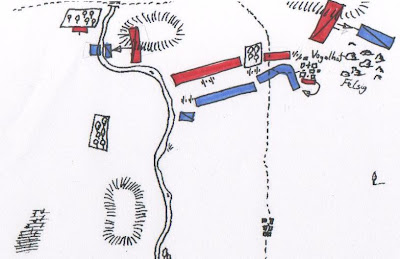
Map of the battle: Initial moves
As dawn light gathered the Aschenbach army approached the enemy on both sides of the river, the isolated detachment under von Kress functioning perfectly well in isolation. Sweeping on, the Aschenbach infantry on the right of their line under General Grenwitz forged ahead to attack the village of Vogelhof. IR7 von Dunkel’s men rapidly learned that grenadiers might be a tough prospect in the open, but behind stone and timber they were even more dangerous. Even forced by this to refuse a flank, the Aschenbach line swept on, folding smoothly out into line and perfectly timing it’s attack to take the initiative in the ensuing firefight. The Luftberg infantry were outclassed man for man, but with batteries of guns hidden all along their line they managed to hold their own. Everywhere, batteries of guns fired into the oncoming enemy, especially from the small wood bristling with cannon in the centre of the Luftberg line.
The infantry lines clash, as viewed from Vogelhof
General von Kleintrink had moved his cavalry forward, only to realise that with Vogelhof in hostile hands he couldn’t move ahead to turn the enemy flank. To sit tight was possibly the best course, but for Graf Erich von Kleintrink, the man who had demolished the enemy flank at Neukatzberg, such a thing was unthinkable. The only option to get at the enemy was a risky change into column, in order to slip through a narrow passage through the rocky ground east of the village. If he moved fast enough, outpacing the more sluggish enemy commanders, he could fall on the enemy’s flank and rear before they responded and win yet another battle…
von Kleintrink flanks the rocky ground

Initial combat and outflanking moves
Wednesday, July 23, 2008
First Moves
Aschenbach's army (shown in blue) was initially based in the capital of Flussburg, but an agressive advance was the most likely to be rewarding. Full of enthusiasm after Neukatzberg, Gerdt von Krumper was in no mood for sitting around. He took his full army east, intending to threaten a Luftberg advance on the capital as well as his river crossing supply source.
Elector Ulrich von Luftberg had an answer, however. Clearly, his defeat at Neukatzberg had had a salutary effect and the previous months had not been idled away with operas, gambling and reading scandalous French novels. He moved his main army north off the main approach to Flussburg, and settled into defensive positions around the small village of Vogelhof. At the same time, a detatchment of all the light cavalry under General Van Der Dijk was sent racing westwards to cut the supply route from Krumper's depot at Lauch. Unfolding with such speed that he wasn't able to respond, Krumper suddenly finds himself isolated and with serious problems.
The damnable raiding isn't helping either. No Aschenbach forage party is safe, with every farmhouse stuffed full of Croats, and every shrub concealing a squadron of Hussars. Already, forces have been melting away. Compounding the misery, even Aschenbach's slender resources for irregular warfare have been raiding away on their opponents. Before they'd even met in battle, each army had lost the equivalent of two or three regiments' worth of strength points. While the larger Luftberg army simply disbanded it's less senior regiments (IR's 10 & 11 have simply been drained for manpower and sent home to recruit for next year), Aschenbach has simply spread the pain and reduced it's infantry and cavalry regiments by a point each.
Sitting in his tent, it's clear to von Krumper that this can't go on. The longer the campaign drags by, the worse it will get - a battle is needed, and quickly, to turn things around. Scouts indicate that the Luftberg army has been preparing itself at Vogelhof, but the potential gains outweigh the risks. If the Luftberg army is defeated, it can be pushed back to it's bridgehead over the Rhine and a comprehensive victory can be claimed by Aschenbach.
The subordinate commanders are eagerly anticipating their orders of march, and surely won't be disappointed. Time to get that Cuirass polished up...
Monday, July 21, 2008
Campaign summary
So, what issues will concern the armies on campaign? The first will be supply. As is fitting for an 18th Century army, it’s all by fixed depots and supply routes. Each army draws supply from a friendly city or town just over the border, which allows them to operate through most of the province. Flussburg will also be counted as a depot, so to operate fully in the province and go where they wish they’ll need to hold it. Flussburg is also pretty important in itself, as any attempt to claim ownership of the province can hardly be conclusive while it remains in enemy hands.For the Luftberg side, the river adds another challenge. The crossing point created by the sappers will be a natural bottleneck for their army, and communication back to their home country. As such, holding it and maintaining links home will be a prerequisite of a good victory.
As Luftberg are the invaders, I’ll grade things from their point of view. They will get a point for each of the following:
1) Holding a route from Luftberg into the province across the river
2) Defeat the Aschenbach army in a pitched battle which involves at least 50% of it’s units
3) Capture Flussburg and hold it at the end of the campaign year.
It should be pretty easy to quantify if each objective has been met or failed. The battle victory requirement of 50% is to make sure that some skirmish isn’t taken as a decisive victory – the bulk of the enemy have to be grappled with before it counts.
Luftberg will be awarded a decisive victory if it fulfils all three conditions. Meeting two will be a major victory, and only one will be a minor victory. Anything else is a defeat, with Aschenbach winning the campaign.
Luftberg Army OoB
Infanterie Regimenter
Grenadiers ('Pilsen' Grenadiers)
IR 1 Radetzky
IR 2 Doppler
IR 3 O'Brien
IR 4 Negrelli
IR 5 v. Trapp
IR 6 Karlovic (Croats)
IR 7 v. Stiegl
IR 8 Schrammel
IR 9 Bartok
IR 10 Hohenwerfen
IR 11 Steinkopf
Kurassier Regimenter
KR 1 Haas
KR 2 Schrodinger
KR 3 Klimt
Dragoner Regimenter
DR 1 Raab
DR 2 Krauss
DR 3 Hortenburg
Husaren Regimenter
HR 1 Rotwang
HR 2 Schiele
Feld-artillerie #1
Feld-artillerie #2
Feld-artillerie #3
As with the Aschenbach army, the artillery has been expanded to three batteries, cavalry is largely unaltered, but infantry has been expanded. IR 6 (Karlovic) is a Croat regiment of irregulars, but all others are regular line infantry regiments. Generals are:
Faldmarschall Konig Ulrich Von Luftberg (Average General)
General Conrad von Hentsch (* +1)
General La Spezia (+0)
General Figling (-1 V)
General Van der Dijk (+1)
General Kohl (+0)
General Frundsberg (* +0)
General Steinkopf (-2)
As you can see, they’re a generally poorer bunch than the more professional Aschenbach commanders, but that’s what happens when you recruit officers from a roving band of cosmopolitan adventurers. General Steinkopf, in particular, appears to be all but catatonic.
Overall, the Luftberg army has parity to it’s rival in guns, a 3:2 superiority in Cavalry, a slight edge in regular infantry, and a big strategic advantage in terms of irregular warfare (scouting, raids, etc.)
Saturday, July 19, 2008
Aschenbach Army OoB
Anyway, here’s the expanded Aschenbach OoB:
Infanterie Regimenter
Grenadiers v. Schott (‘The Hirschburgers’)
IR 1 v. Zaub Fuss-Garde
IR 2 v. Klink
IR 3 v. Grumble
IR 4 v. Hoffmann
IR 5 v. Moglich
IR 6 v. Rechnung
IR 7 v. Dunkel
IR 8 v. Grappel
Kurassier Regimenter
KR 1 v. Schnitzel
KR 2 v. Kurbitz
Dragoner Regimenter
DR 1 v. Fleiger
DR 2 v. Flunck
Husaren Regimenter
HR 1 v. Ritter
Feld-Artillerie #1
Feld-Artillerie #2
Feld-Artillerie #3
It’s pretty close to the old one, but there have been a few changes. IR 4 (Hoffmann) has been changed to a formed regular line infantry regiment, as opposed to the skirmishers of before. The newly-raised IR’s 5 to 7 are also line musketeers, but IR 8 (Grappel) is a Fusilier regiment. Cavalry is unaltered, while the artillery has been expanded to take on a third battery (as I had some spare cannons).
Officers in charge of this are listed below. To explain the system used by M&R, officers marked ‘*’ are exceptional (meaning they can act more independently) while ‘V’ means they are valorous (inspirational to troops). The number modifier represents ability, the higher the better.
Feldmarschall Prinzregent G. v. Krumper (Good Commander)
General Graf Erich v. Kleintrink (* +1 V)
General Bunzel (+1)
General Kress (* +1)
General Grenwitz (* +2)
General v. Zaub (* -1 V)
Wait a minute! What’s General Von Zaub doing at the end? Well, after his performance at Neukatzberg (and in my capacity as the Regent Von Krumper) I’ve promoted him. I also decided that if the coming war is over his family’s lands, giving him a command helps tie his family more to Aschenbach, which is probably a wise move (ah, these dynastic appointments...) IR 1 will usually be noted as the Foot Guards, but to save confusing renaming it will still be technically v. Zaub’s regiment – he’ll just be an absent honorific regimental chef. The other three generals are randomly generated, as per the M&R system.